Instructor: Lingqi Yan | UCSB Bilibili: https://www.bilibili.com/video/BV1X7411F744
1 Vector Basics
Definition of Vectors
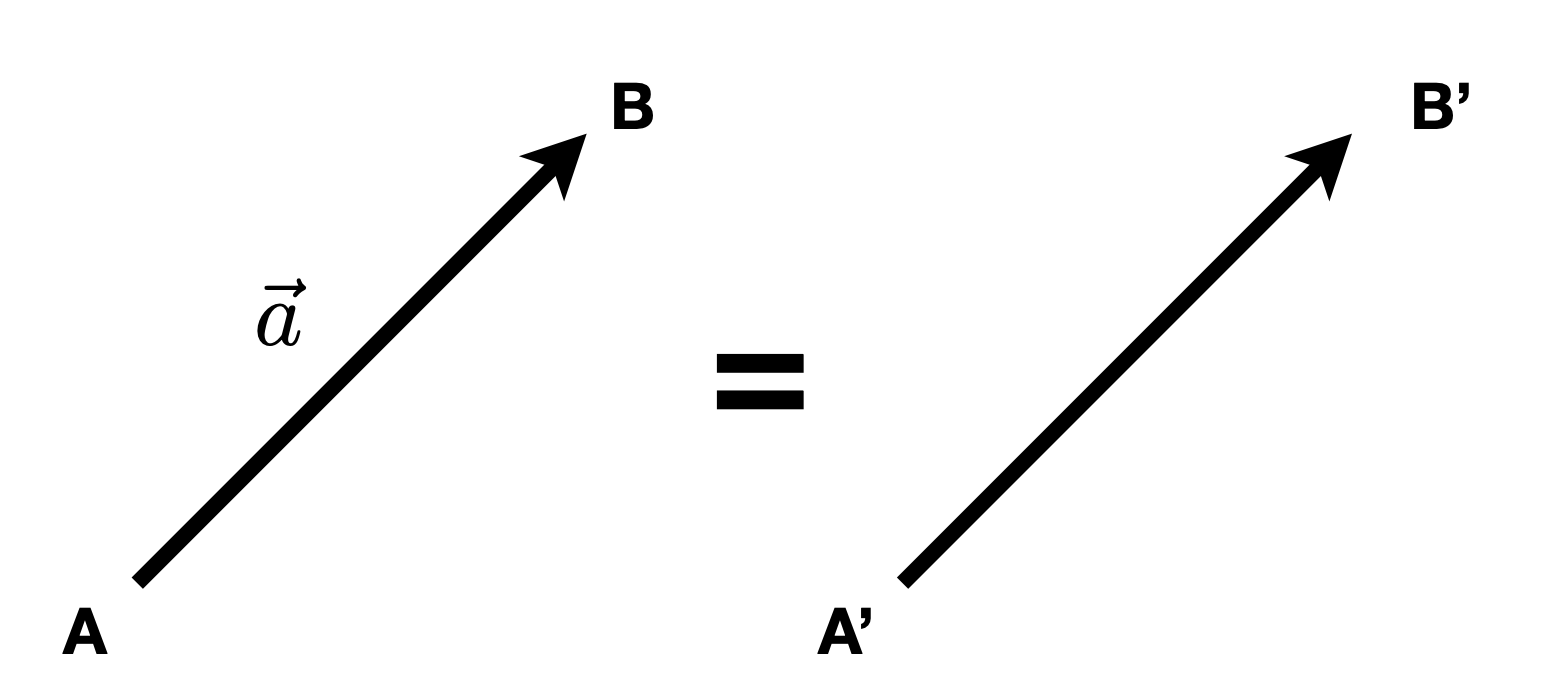
- Vectors have direction and length, but no absolute starting position
- Commonly denoted as $\vec{a}$ or bold a
- Represented by start and end points: $\overrightarrow{AB} = B - A$
Vector Normalization
- Magnitude (length) of a vector: $||\vec{a}||$
- Unit vector: A vector with magnitude 1, used to represent direction
- Normalization: $\hat{a} = \frac{\vec{a}}{||\vec{a}||}$
Vector Addition
- Geometric representation: Parallelogram law & triangle law
- Algebraic calculation: Add corresponding coordinates
Geometric representation of vector addition:
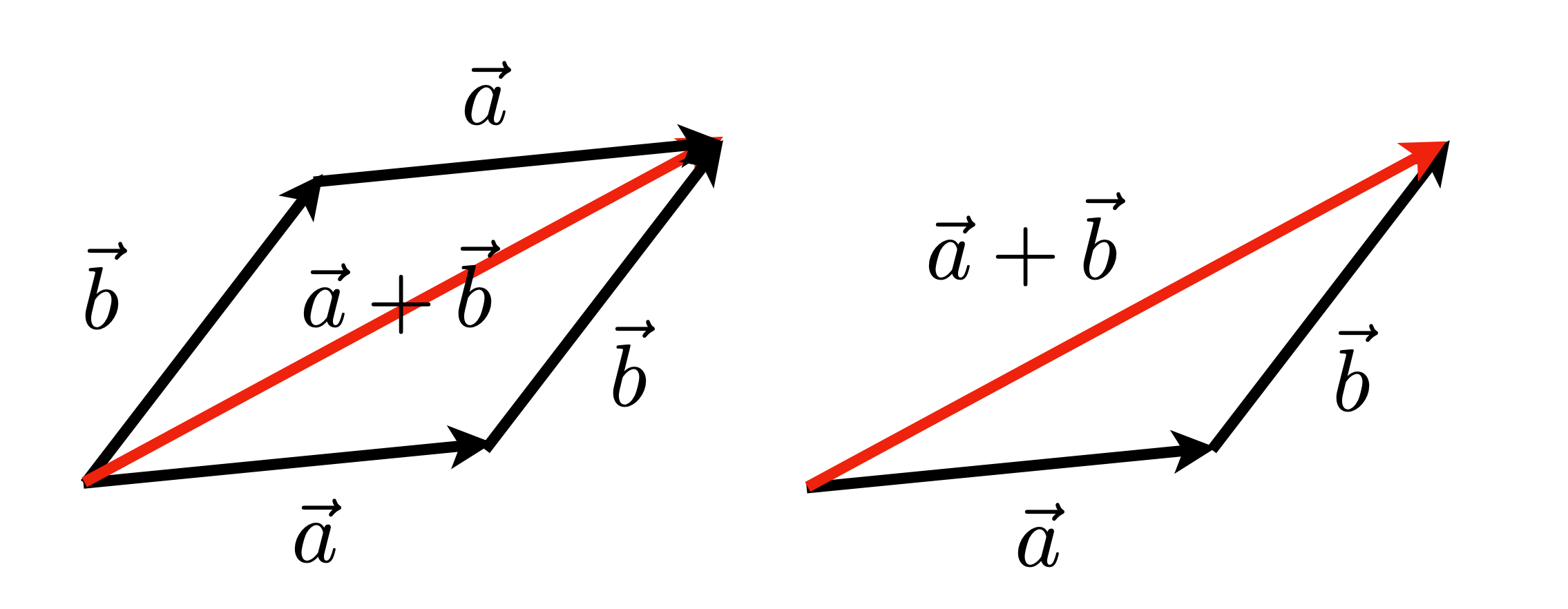
Parallelogram law: $\vec{a} + \vec{b} = \vec{b} + \vec{a}$ (commutative) Triangle law: $\vec{a}$ first, then $\vec{b}$, connected end to end
Cartesian Coordinate System
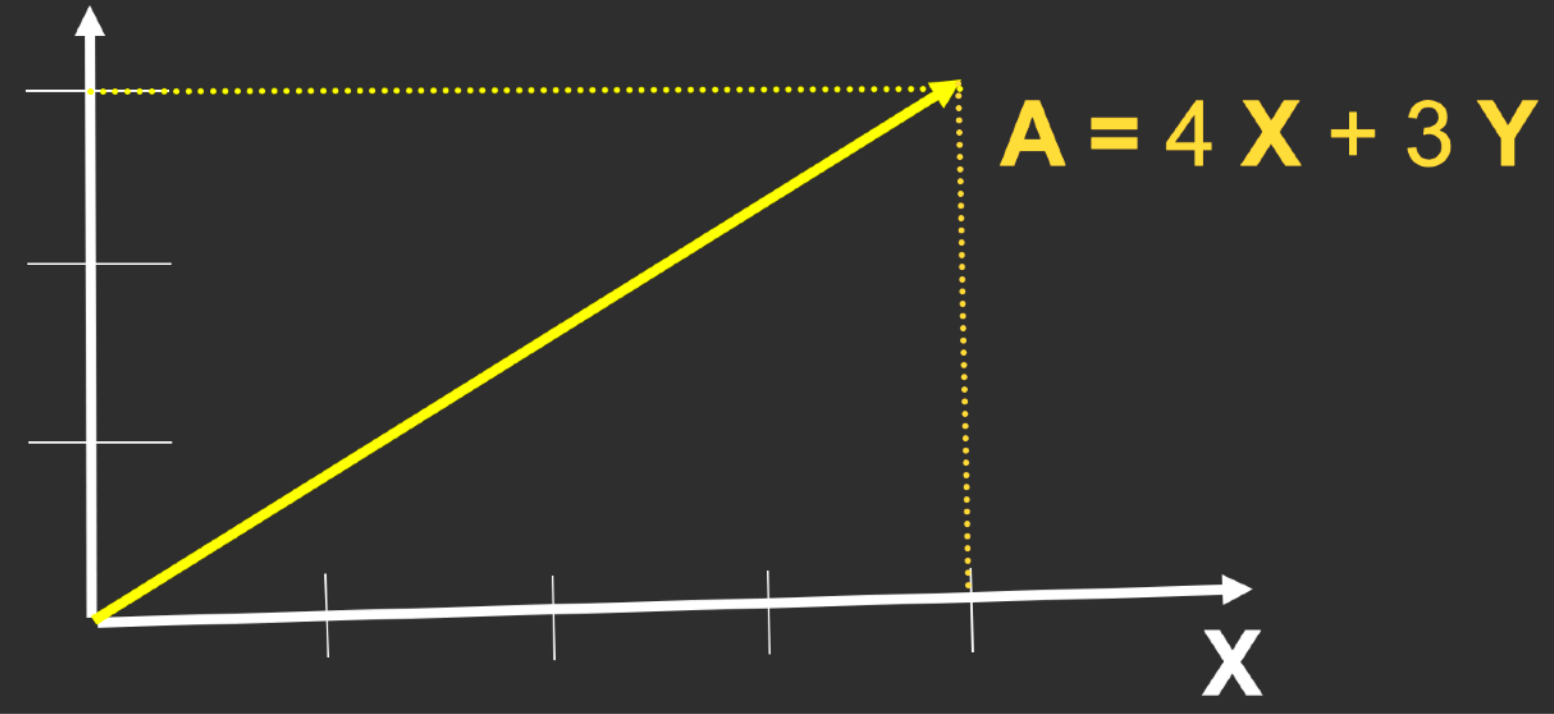
2 Vector Multiplication
Dot Product (Scalar Product)
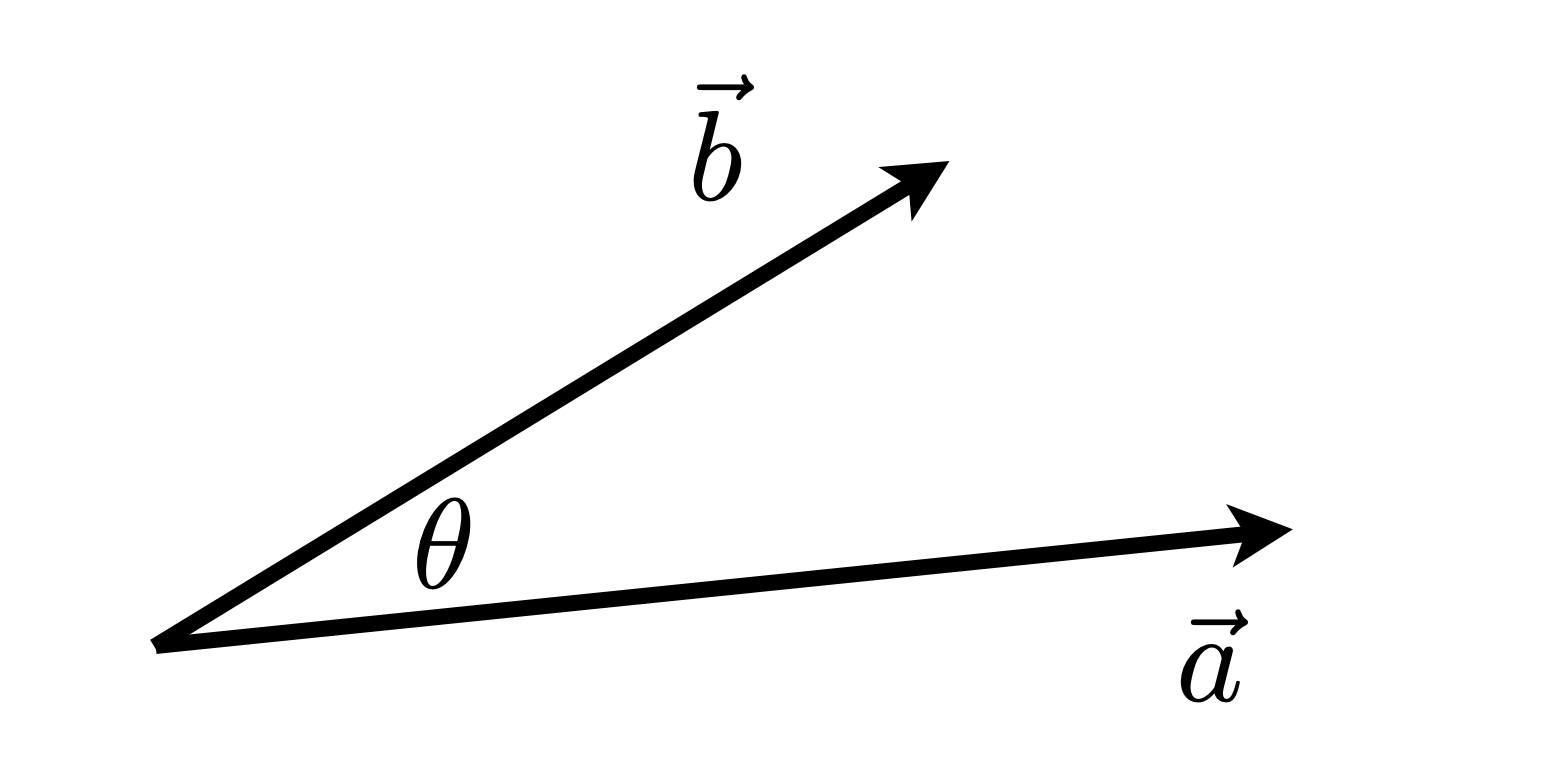
The dot product computes a scalar, solving how similar two vectors are (projection, angle, intensity).
Definition:
$$ \vec{a} \cdot \vec{b} = ||\vec{a}|| \cdot ||\vec{b}|| \cdot \cos\theta $$$$ \cos\theta = \frac{\vec{a} \cdot \vec{b}}{||\vec{a}|| \cdot ||\vec{b}||} $$For unit vectors: $\cos\theta = \hat{a} \cdot \hat{b}$
Coordinate calculation:
- 2D: $\vec{a} \cdot \vec{b} = x_a x_b + y_a y_b$
- 3D: $\vec{a} \cdot \vec{b} = x_a x_b + y_a y_b + z_a z_b$
Properties:
| Property | Formula |
|---|---|
| Commutative | $\vec{a} \cdot \vec{b} = \vec{b} \cdot \vec{a}$ |
| Distributive | $\vec{a} \cdot (\vec{b} + \vec{c}) = \vec{a} \cdot \vec{b} + \vec{a} \cdot \vec{c}$ |
| Associative | $(k\vec{a}) \cdot \vec{b} = \vec{a} \cdot (k\vec{b}) = k(\vec{a} \cdot \vec{b})$ |
Applications in Graphics:
- Calculate angle between vectors (e.g., angle between light and normal)
- Vector projection: Projection of $\vec{b}$ onto $\vec{a}$ is $\vec{b}_\perp = (\vec{b} \cdot \hat{a})\hat{a}$
- Determine direction: dot product > 0 same direction, < 0 opposite, = 0 perpendicular
Geometric meaning of dot product:
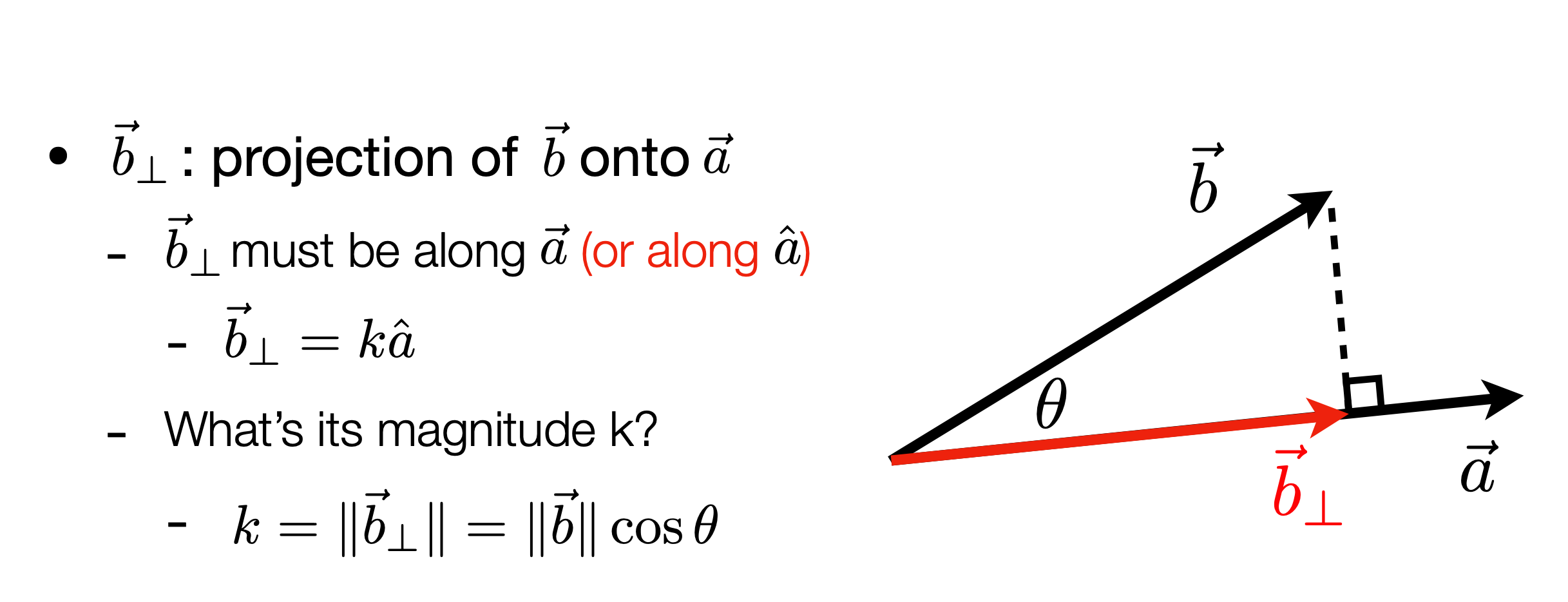
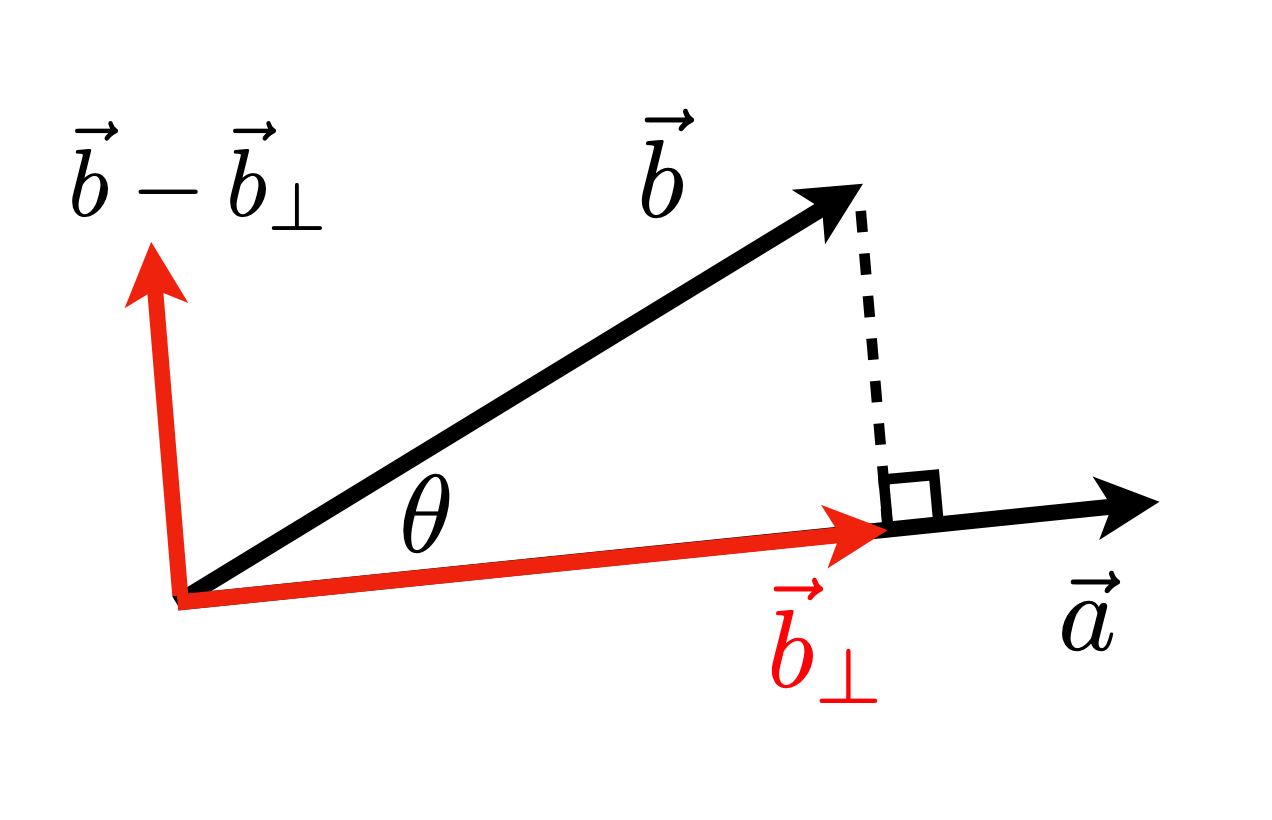
Calculate angle: $\cos\theta = \frac{\vec{a} \cdot \vec{b}}{||\vec{a}|| \cdot ||\vec{b}||}$ Vector projection: $\vec{b}_\perp = (\vec{b} \cdot \hat{a})\hat{a}$
Dot product for direction detection:
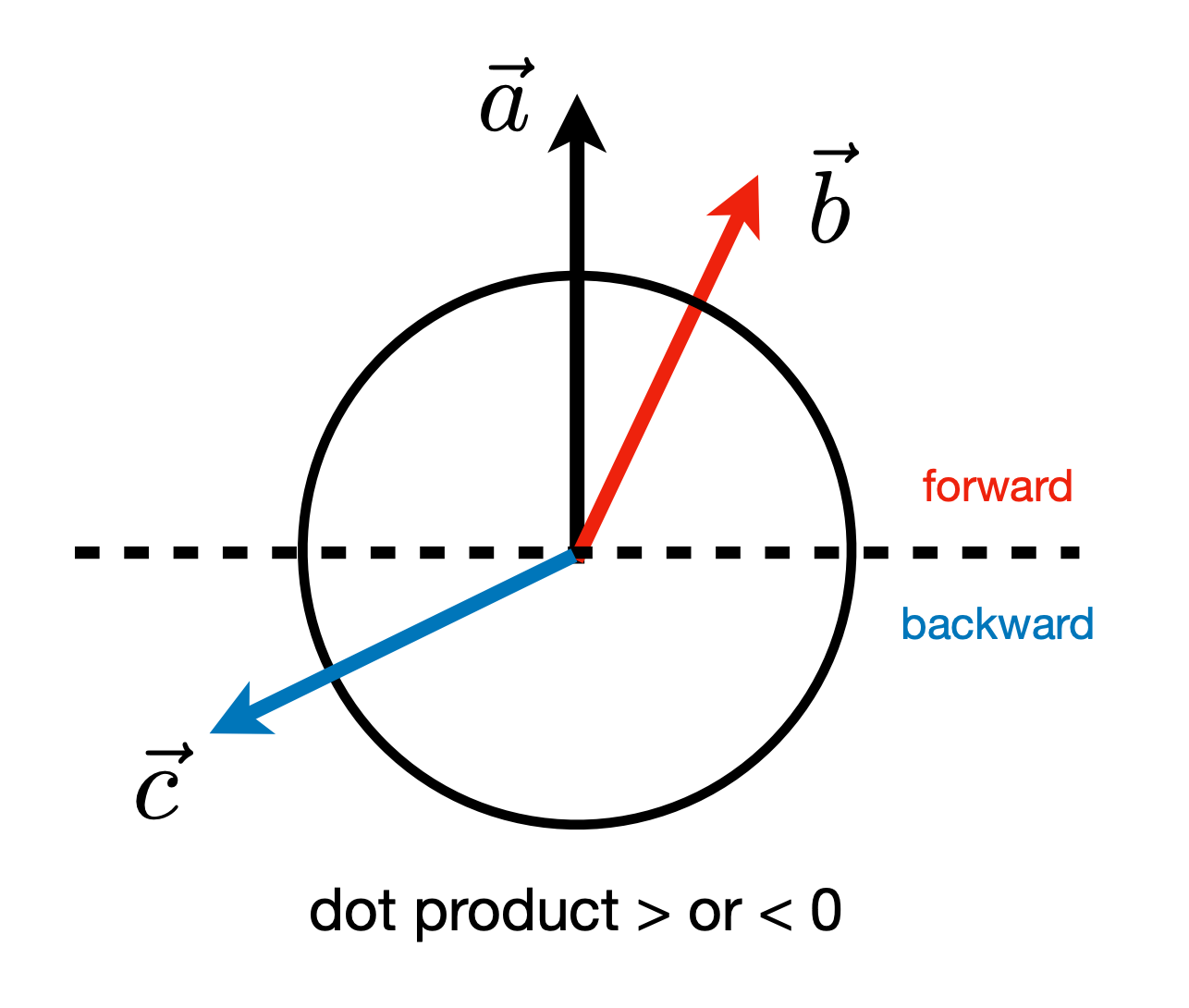
- $\vec{a} \cdot \vec{b} > 0$: same direction ($\theta < 90°$)
- $\vec{a} \cdot \vec{b} = 0$: perpendicular ($\theta = 90°$)
- $\vec{a} \cdot \vec{b} < 0$: opposite direction ($\theta > 90°$)
Cross Product (Vector Product)
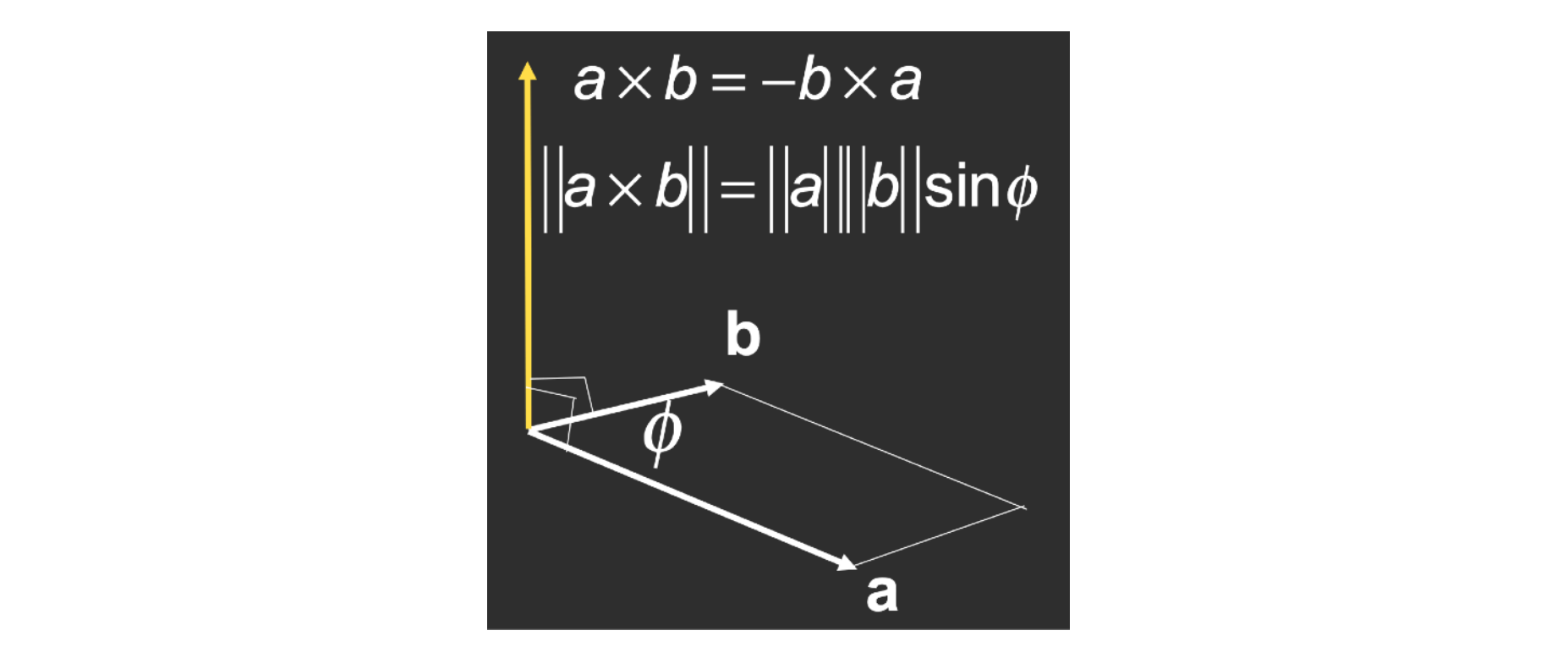
The cross product computes a vector, solving what direction is perpendicular to two vectors (normal, rotation axis, direction).
Definition:
- Cross product result is perpendicular to both input vectors
- Direction determined by the right-hand rule
- Commonly used to construct coordinate systems
Properties:
| Property | Formula |
|---|---|
| Anti-commutative | $\vec{a} \times \vec{b} = -\vec{b} \times \vec{a}$ |
| Self cross product | $\vec{a} \times \vec{a} = \vec{0}$ |
| Distributive | $\vec{a} \times (\vec{b} + \vec{c}) = \vec{a} \times \vec{b} + \vec{a} \times \vec{c}$ |
| Scalar multiplication | $\vec{a} \times (k\vec{b}) = k(\vec{a} \times \vec{b})$ |
Standard orthonormal basis relations:
$$ \vec{x} \times \vec{y} = +\vec{z}, \quad \vec{y} \times \vec{z} = +\vec{x}, \quad \vec{z} \times \vec{x} = +\vec{y} $$Coordinate calculation:
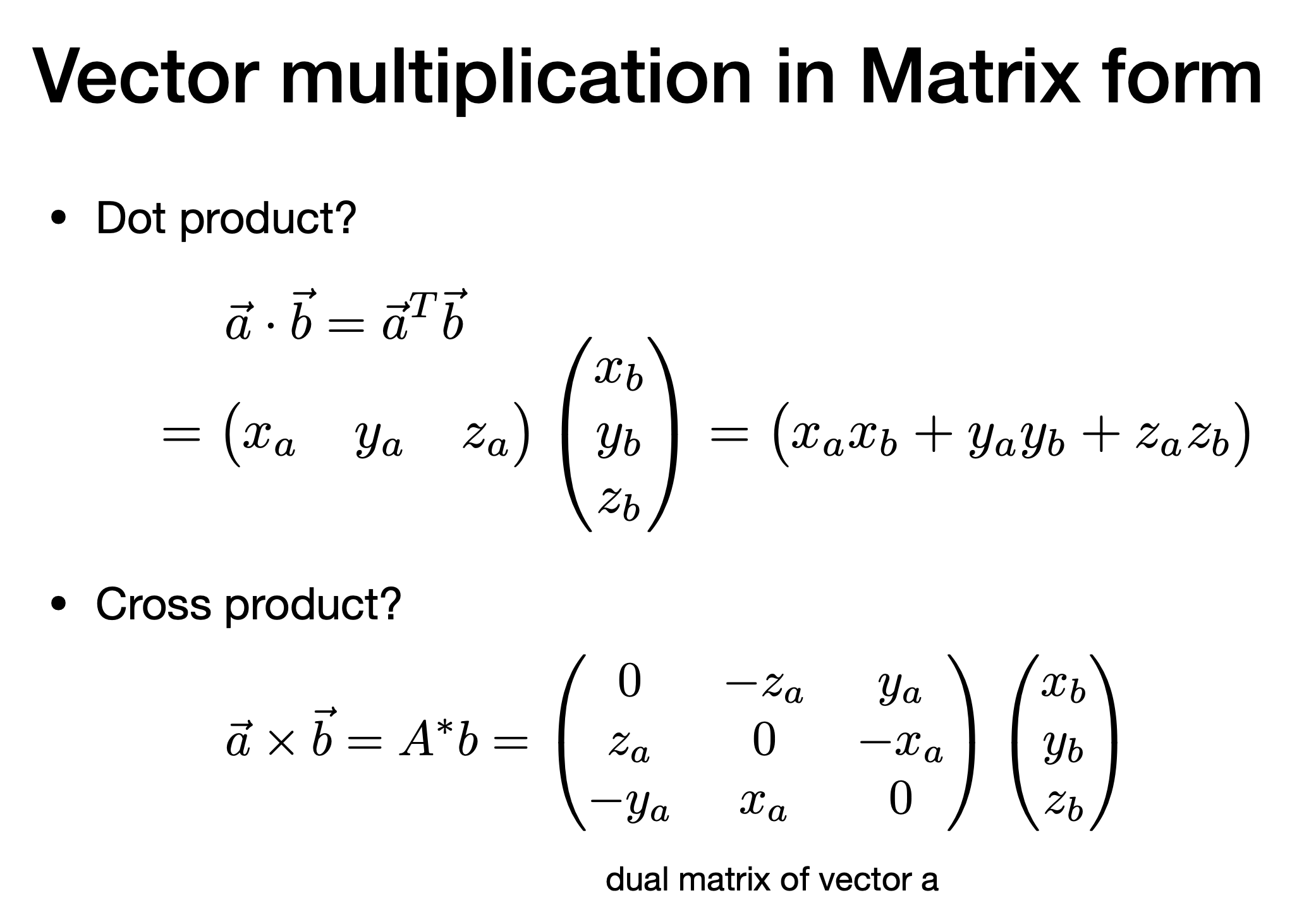
$$ \vec{a} \times \vec{b} = \begin{pmatrix} y_a z_b - y_b z_a \\ z_a x_b - x_a z_b \\ x_a y_b - y_a x_b \end{pmatrix} $$Matrix form (dual matrix):
$$ \vec{a} \times \vec{b} = A^* \vec{b} = \begin{pmatrix} 0 & -z_a & y_a \\ z_a & 0 & -x_a \\ -y_a & x_a & 0 \end{pmatrix} \begin{pmatrix} x_b \\ y_b \\ z_b \end{pmatrix} $$Applications in Graphics:
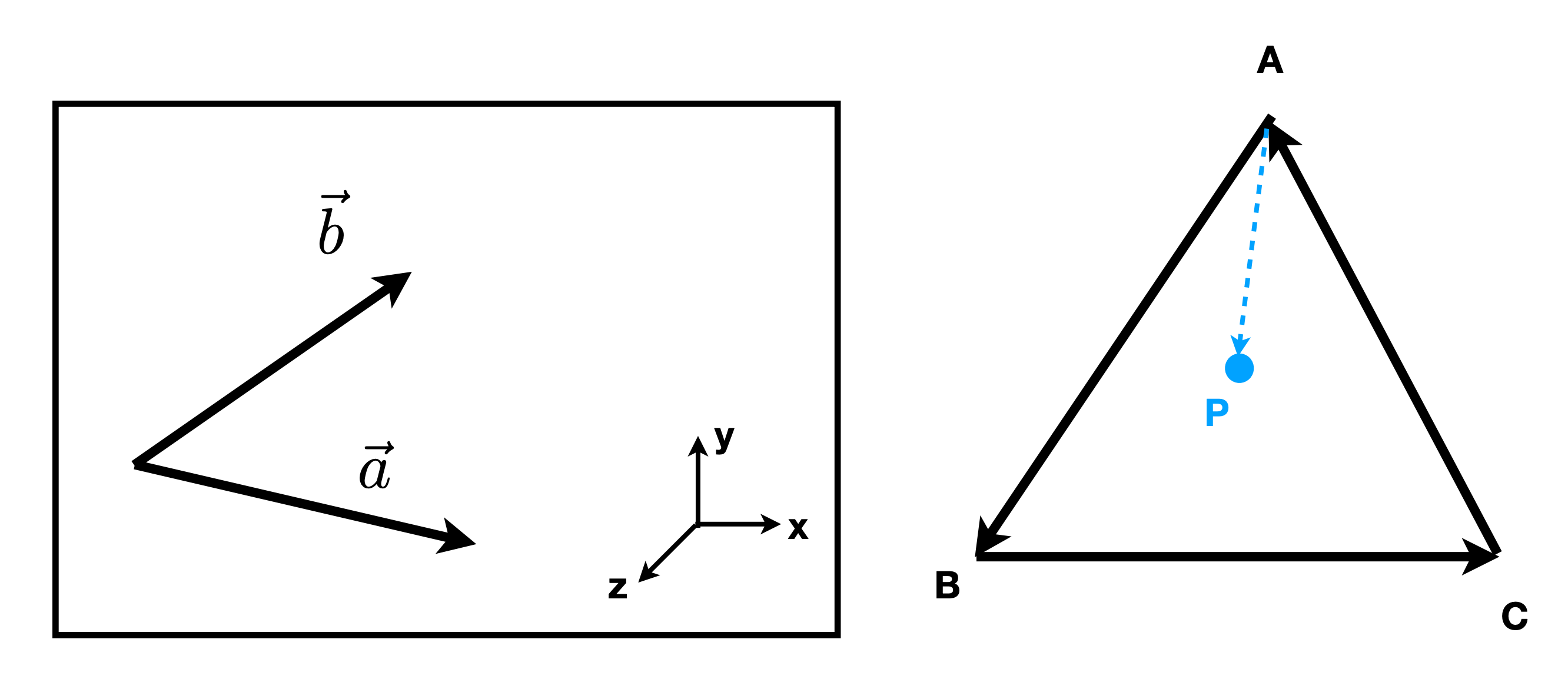
- Determine left/right: Cross product direction determines if a point is on the left or right of a vector. For example, $\vec{a} \times \vec{b}$ corresponds to the positive z-axis direction, meaning $\vec{b}$ is to the left of $\vec{a}$
- Determine inside/outside: Used in triangle rasterization to determine if a point is inside a triangle. For example, $\overrightarrow{AB} \times \overrightarrow{AP}$ means P is to the left of $\overrightarrow{AB}$, $\overrightarrow{BC} \times \overrightarrow{BP}$ means P is to the left of $\overrightarrow{BC}$, $\overrightarrow{CA} \times \overrightarrow{CP}$ means P is to the left of $\overrightarrow{CA}$
- Calculate normal: Cross product of two triangle edges gives the normal vector
Right-hand rule for cross product:
Right-hand screw rule: right hand in thumbs-up position, $\vec{a} \times \vec{b}$, four fingers curl from $\vec{a}$ to $\vec{b}$, thumb direction is the z-axis direction
- $\vec{a} \times \vec{b}$ is perpendicular to the plane formed by $\vec{a}$ and $\vec{b}$
- Direction determined by right-hand rule: fingers curl from $\vec{a}$ toward $\vec{b}$, thumb points to cross product direction
Cross product for left/right and inside/outside detection:
Left/right detection: $\vec{a} \times \vec{b}$ result is positive → $\vec{b}$ is to the left of $\vec{a}$
Inside/outside detection: If $P$ is on the same side (left side) of $\overrightarrow{AB}$, $\overrightarrow{BC}$, $\overrightarrow{CA}$, then $P$ is inside the triangle Used in triangle rasterization to determine if a pixel is inside a triangle
Orthogonal coordinate system conditions:
$$ ||\vec{u}|| = ||\vec{v}|| = ||\vec{w}|| = 1 \quad \text{(unit vectors)} $$$$ \vec{u} \cdot \vec{v} = \vec{v} \cdot \vec{w} = \vec{u} \cdot \vec{w} = 0 \quad \text{(mutually perpendicular)} $$$$ \vec{w} = \vec{u} \times \vec{v} \quad \text{(right-handed system)} $$3D Cartesian coordinate system
Decomposition of arbitrary vectors:
$$ \vec{p} = (\vec{p} \cdot \vec{u})\vec{u} + (\vec{p} \cdot \vec{v})\vec{v} + (\vec{p} \cdot \vec{w})\vec{w} $$Application scenarios:
- Coordinate system transformation: world coordinates, model coordinates, camera coordinates, local coordinates
- Foundation for MVP transformation in subsequent lessons
Orthogonal coordinate system and vector decomposition:
Orthogonal coordinate system conditions: $||\vec{u}|| = ||\vec{v}|| = ||\vec{w}|| = 1$, mutually perpendicular, $\vec{w} = \vec{u} \times \vec{v}$
Vector decomposition: $\vec{p} = (\vec{p} \cdot \vec{u})\vec{u} + (\vec{p} \cdot \vec{v})\vec{v} + (\vec{p} \cdot \vec{w})\vec{w}$
Relationships between different coordinate systems:
Coordinate system transformation: Model coordinates → World coordinates → Camera coordinates → Clip coordinates (MVP transformation)
3 Matrices
Basic Matrix Concepts
- $m \times n$ matrix: an array with $m$ rows and $n$ columns
- Addition and scalar multiplication: element-wise operations
Matrix Multiplication
Dimension requirement: $(M \times N) \times (N \times P) = (M \times P)$
$$ C_{ij} = \sum_{k=1}^{N} A_{ik} \cdot B_{kj} $$- $c_{ij}$ denotes element at row $i$, column $j$ of C
- $a_{ik}$ denotes element at row $i$, column $k$ of A
- $b_{kj}$ denotes element at row $k$, column $j$ of B
Given:
$$\mathbf{A} = \begin{bmatrix} a_{11} & a_{12} \\ a_{21} & a_{22} \end{bmatrix}, \quad \mathbf{B} = \begin{bmatrix} b_{11} & b_{12} \\ b_{21} & b_{22} \end{bmatrix}$$Then:
$$\mathbf{AB} = \begin{bmatrix} a_{11}b_{11} + a_{12}b_{21} & a_{11}b_{12} + a_{12}b_{22} \\ a_{21}b_{11} + a_{22}b_{21} & a_{21}b_{12} + a_{22}b_{22} \end{bmatrix}$$$$ \begin{pmatrix} 1 & 3 \\ 5 & 2 \\ 0 & 4 \end{pmatrix} \begin{pmatrix} 3 & 6 & 9 & 4 \\ 2 & 7 & 8 & 3 \end{pmatrix} = \begin{pmatrix} 9 & 27 & 33 & 13 \\ 19 & 44 & 61 & 26 \\ 8 & 28 & 32 & 12 \end{pmatrix} $$How to compute: take row 2, column 4 (value 26) as example. Row 2 values are 5 and 2, column 4 values are 4 and 3. Dot product: $5*4 + 2*3 = 26$
Properties:
| Property | Description |
|---|---|
| Non-commutative | $AB \neq BA$ (in general) |
| Associative | $(AB)C = A(BC)$ |
| Distributive | $A(B+C) = AB + AC$ |
Matrix-Vector Multiplication
- Vectors treated as column matrices ($m \times 1$)
- Foundation for transformations (reflection, rotation, scaling)
Matrix transformation example:
Reflection about y-axis: $\begin{pmatrix} -1 & 0 \\ 0 & 1 \end{pmatrix} \begin{pmatrix} x \\ y \end{pmatrix} = \begin{pmatrix} -x \\ y \end{pmatrix}$
Matrix Transpose
A 2×3 matrix transposed becomes a 3×2 matrix — rows and columns are swapped.
$\begin{pmatrix} 1 & 2 \\ 3 & 4 \\ 5 & 6 \end{pmatrix}^T = \begin{pmatrix} 1 & 3 & 5 \\ 2 & 4 & 6 \end{pmatrix}$
$$ (A^T)_{ij} = A_{ji}, \quad (AB)^T = B^T A^T $$Identity Matrix and Inverse Matrix
$I_{3 \times 3} = \begin{pmatrix} 1 & 0 & 0 \\ 0 & 1 & 0 \\ 0 & 0 & 1 \end{pmatrix}$
Matrix inverse: two matrices multiply to give the identity matrix.
- Identity matrix $I$: diagonal elements are 1, others are 0, $AI = IA = A$
- Inverse matrix $A^{-1}$: $AA^{-1} = A^{-1}A = I$, $(AB)^{-1} = B^{-1}A^{-1}$
$A^{-1}$ is called the inverse matrix of $A$, where $I$ is the identity matrix.
Note: Only square matrices (rows = columns) with non-zero determinant (full rank) have inverse matrices.
Methods for computing inverse matrices
Camera rotation and translation.
This article is note #2 in the GAMES101 - Modern Computer Graphics learning series.